
The FORWARD Study
An open-label study to evaluate the pharmacokinetics, pharmacodynamics, efficacy, and safety of a single dose of tanruprubart (ANX005) in participants with Guillain-Barré Syndrome (GBS).
The FORWARD Study
An open-label study to evaluate the pharmacokinetics, pharmacodynamics, efficacy, and safety of a single dose of tanruprubart (ANX005) in participants with Guillain-Barré Syndrome (GBS).
This website is intended for healthcare professionals only.
The FORWARD Study
An open-label study to evaluate the pharmacokinetics, pharmacodynamics, efficacy, and safety of a single dose of tanruprubart (ANX005) in participants with Guillain-Barré Syndrome.
An open-label study to evaluate the pharmacokinetics, pharmacodynamics, efficacy, and safety of a single dose of tanruprubart (ANX005) in participants with Guillain-Barré Syndrome (GBS).

About Guillain-Barré Syndrome
Guillain-Barré Syndrome (GBS) is a rare, serious, and life-threatening neuromuscular emergency. Key clinical features:
- Symmetrical, ascending weakness, often developing first in the legs
- Sensory symptoms (prickling, tingling, numbness)
- Autonomic dysfunction
- Hypo- or Areflexia is common
There is significant morbidity, long-term disability, and mortality associated with GBS, despite use of current standards of care.
About Guillain-Barré Syndrome
Guillain-Barré Syndrome (GBS) is a rare, serious, and life-threatening neuromuscular emergency. Key clinical features:
- Symmetrical, ascending weakness, often developing first in the legs
- Sensory symptoms (prickling, tingling, numbness)
- Autonomic dysfunction
- Hypo- or Areflexia is common
There is significant morbidity, long-term disability, and mortality associated with GBS, despite use of current standards of care.
Tanruprubart: an investigational single-dose therapy
- Tanruprubart is a single-dose monoclonal antibody treatment that is designed to reduce damage and inflammation by inhibiting C1q, the initiator of the classical complement pathway, and preventing its binding to peripheral nerves.
- Tanruprubart is intended to be given early in the active disease process to limit the signs and symptoms of GBS. In previous studies, Tanruprubart 30mg/kg has been shown to have an onset for inhibition of the classical complement pathway within 24 hours.
- Tanruprubart is not currently approved by the FDA.
Tanruprubart: an investigational single-dose therapy
Tanruprubart is a single-dose monoclonal antibody treatment that aims to reduce damage and inflammation by inhibiting C1q, the initiator of the classical complement pathway, and preventing its binding to peripheral nerves.
Tanruprubart is intended to be given early in the active disease process to limit the signs and symptoms of GBS. In previous studies, Tanruprubart 30mg/kg has been shown to have an onset for inhibition of the classical complement pathway within 24 hours.
Tanruprubart is not currently approved by the FDA.
About the FORWARD Study
Target number of participants: 30
Study duration per participant: 26 weeks

About the FORWARD Study
Target number of participants: 30
Study duration per participant: 26 weeks
Key Inclusion Criteria
- Diagnosed with Guillain-Barré Syndrome according to NINDS diagnostic criteria
- 12 to 85 years of age
- Onset of GBS-related weakness 10 days or less before Day 1 infusion
- GBS-Disability Score (GBS-DS) of 3, 4, or 5 at Screening and before Day 1 infusion
Key Exclusion Criteria
- History of autoimmune disorder or a previous episode of Guillain-Barré Syndrome
- Previous or planned treatment with eitherIVIg or PE within 90 days of Day 1
Key Inclusion Criteria
- Diagnosed with Guillain-Barré Syndrome according to NINDS diagnostic criteria
- 12 to 85 years of age
- Onset of GBS-related weakness 10 days or less before Day 1 infusion
- GBS-Disability Score (GBS-DS) of 3, 4, or 5 at Screening and before Day 1 infusion
Key Exclusion Criteria
- History of autoimmune disorder or a previous episode of Guillain-Barré Syndrome
- Previous or planned treatment with eitherIVIg or PE within 90 days of Day 1
The safety of tanruprubart is still being evaluated. It is a monoclonal antibody and may cause immune-related adverse effects. The investigator will review the potential benefits and risks with the patient.
The safety of tanruprubart is still being evaluated. It is a monoclonal antibody and may cause immune-related adverse effects. The investigator will review the potential benefits and risks with the patient.
Tanruprubart has been studied in over 200 patients with GBS
In a previous study, more than 200 people diagnosed with Guillain-Barré Syndrome received a dose of tanruprubart or placebo. A placebo is a treatment that has no active drug.
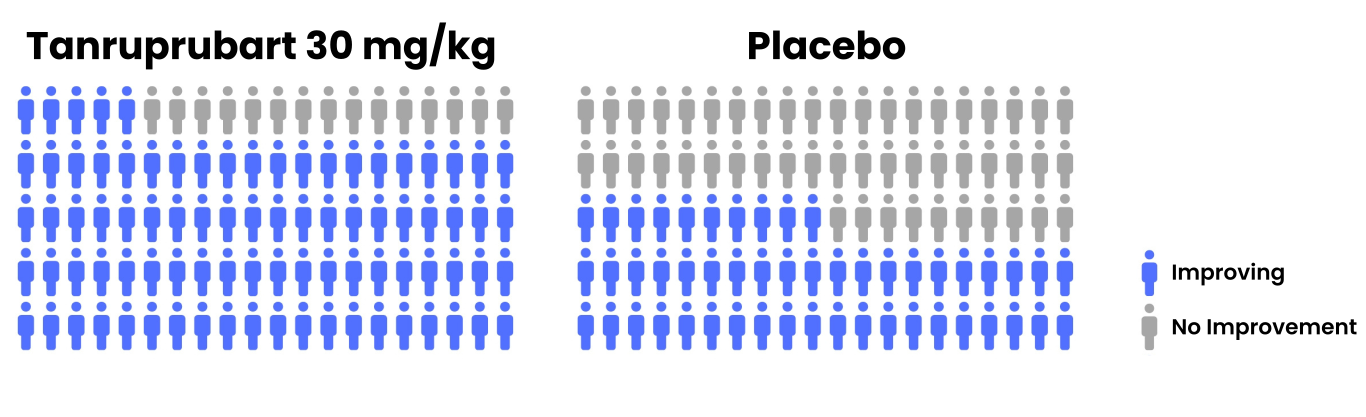
In this study, more than 85% of patients who received the dose of tanruprubart being tested in the FORWARD study showed improvements in muscle strength and function as early as the first week compared to about 50% of patients who received the placebo.
The most common side effects in this study were reactions related to the infusion. These side effects were typically a rash. Some participants experienced an increased heart rate or a drop in blood pressure, which got better with treatment.
Tanruprubart has been studied in over 200 patients with GBS
In a previous study, more than 200 people diagnosed with Guillain-Barré Syndrome received a dose of tanruprubart or placebo. A placebo is a treatment that has no active drug.
In this study, more than 85% of patients who received the dose of tanruprubart being tested in the FORWARD study showed improvements in muscle strength and function as early as the first week compared to about 50% of patients who received the placebo.
The most common side effects in this study were reactions related to the infusion. These side effects were typically a rash. Some participants experienced an increased heart rate or a drop in blood pressure, which got better with treatment.
Results of Previous Studies
Phase 3 study in Guillain-Barré Syndrome
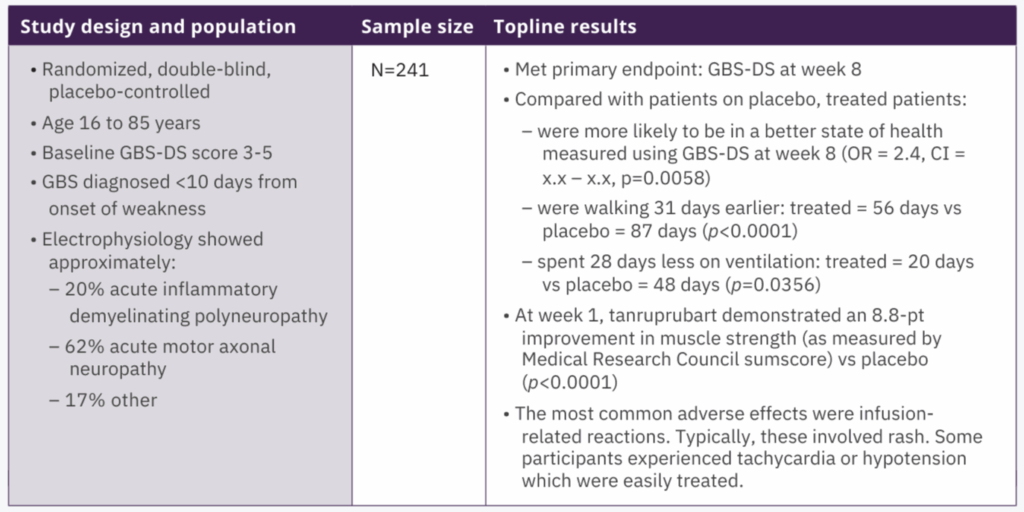
Real-world evidence study comparing tanruprubart to IVIg or PE in matched patients from the International GBS Outcomes Study (IGOS) in Guillain-Barré Syndrome
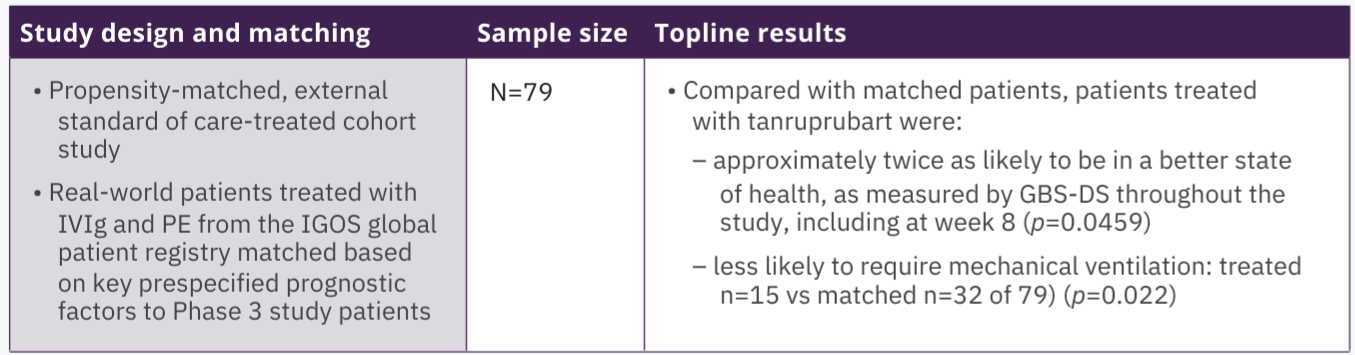
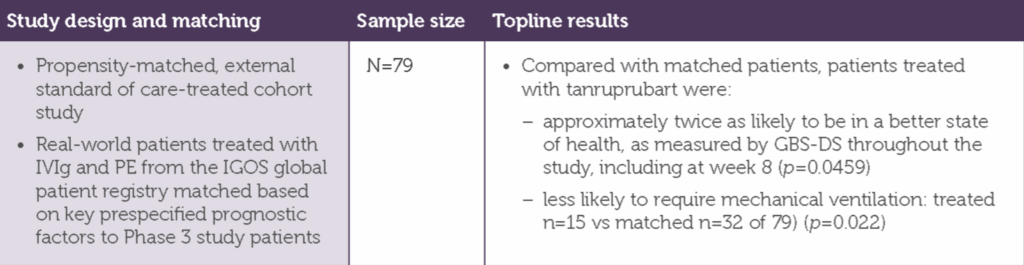
Results of Previous Studies
Phase 3 study in Guillain-Barré Syndrome
Real-world evidence study comparing tanruprubart to IVIg or PE in matched patients from the International GBS Outcomes Study (IGOS) in Guillain-Barré Syndrome
Locate a Site Near You
Enter your zip/postal code below to find a list of your closest treating sites.
GET DIRECTIONS
Find Nearby Service Providers
Use my location to find the closest Service Provider near me
View Description
Locate a Site Near You
Enter your zip/postal code below to find a list of your closest treating sites.
GET DIRECTIONS
Find Nearby Service Providers
Use my location to find the closest Service Provider near me